
Creating Seamless Experiences for Modern Travellers
Airport & Travel Technology:
Creating Seamless Experiences for Modern Travellers
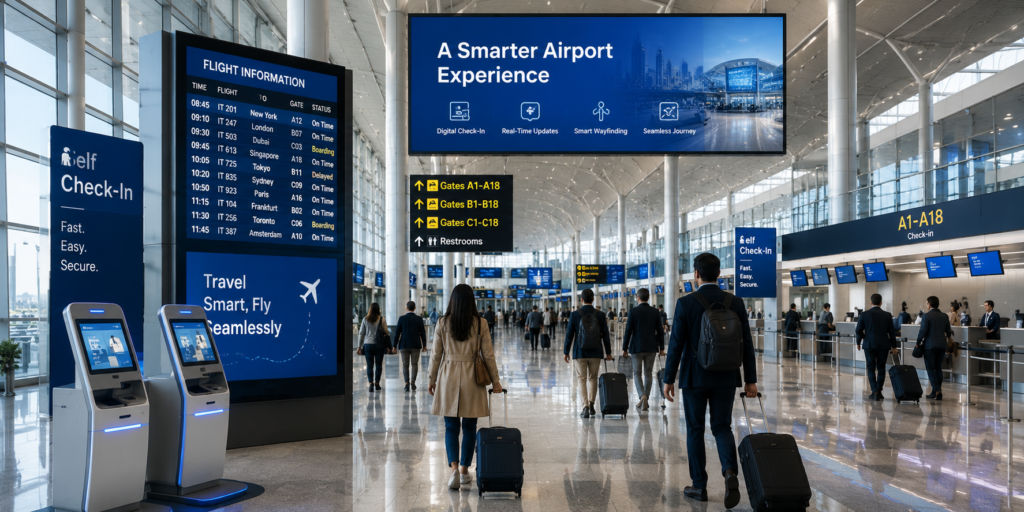
Airport technology is changing the way millions of people travel and if you have ever stood in a long check-in queue, rushed to find your gate, or stressed about your luggage, you are about to discover why that experience is becoming a thing of the past.
But that experience is changing fast. Thanks to a wave of airport and travel technology innovations, the entire journey from booking a ticket to stepping off the plane is being redesigned around one simple idea: making travel easier, faster, and more enjoyable for every passenger.
The Technologies Transforming the Travel Experience
1. Biometric Technology Your Face Is Your Boarding Pass
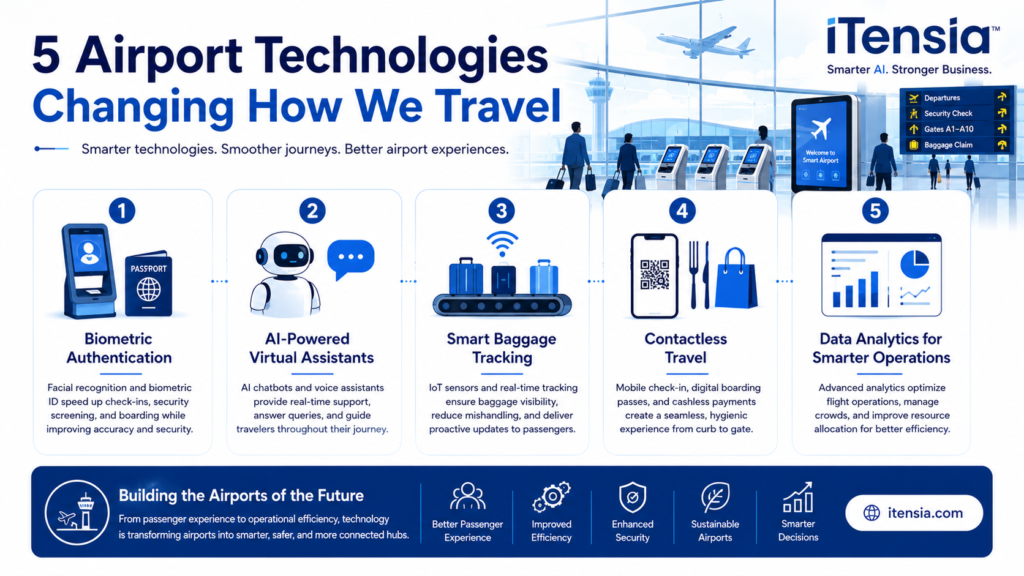
One of the biggest shifts in modern airports is the rise of biometric technology in aviation. Instead of fumbling for your passport and boarding pass at every checkpoint, your face becomes your ID. You walk up to a camera, it scans your face in seconds, and lets you through no paper, no hassle. This technology is already live at Changi in Singapore, Heathrow in London, and Indira Gandhi International in Delhi. According to IATA, biometric technology is now being adopted by over 70 airlines and airports worldwide to speed up passenger processing.
2. AI-Powered Customer Service Help Available 24/7
AI-powered chatbots and virtual assistants are now deployed across airlines and airports to answer passenger questions instantly at any time of day or night. These AI travel assistants can rebook flights, provide gate updates, answer baggage queries, and even suggest things to do during a layover all without a human agent.
3. Smart Baggage Tracking Know Where Your Bag Is
Modern airports tackle lost luggage with smart baggage tracking systems using RFID tags and real-time scanning. Your bag is tracked at every single point from check-in desk to cargo hold to baggage carousel. Passengers receive live updates on their phone. According to SITA Baggage IT Insights Report, mishandled baggage has reduced by 66% since airlines introduced smart tracking technology.
4. Automated Security Screening Faster, Smarter, Safer
New airport security automation technology is changing how security feels. Advanced CT scanners and AI-assisted threat detection screen bags more thoroughly and quickly. Some airports are piloting lanes where passengers do not need to remove laptops or liquids the scanner does the work automatically.
5. Smart Airport Navigation No More Getting Lost
Indoor navigation apps and smart wayfinding systems now guide travelers turn-by-turn through the terminal just like Google Maps, but inside the airport. Some systems even factor in real-time queue lengths to suggest the fastest route to your gate. Changi Airport has been rated the world’s best airport multiple times by Skytrax global rankings.
6. Contactless Travel The Post-Pandemic Standard
From mobile boarding passes and digital wallets to touchless kiosks and app-based lounge access, the entire travel journey is going contact-free. Contactless airport technology means passengers can manage their entire journey from their smartphone.
7. Predictive Analytics Planning Ahead So You Do Not Have To
Airports and airlines use predictive analytics in travel to forecast passenger volumes, manage staffing, predict delays, and optimize gate assignments keeping operations smooth even on the busiest travel days.
Airports Leading the Way in Travel Tech
Changi Airport, Singapore: Consistently ranked the world’s best, Changi uses biometrics, automated immigration, and AI-powered operations for a near-frictionless journey.
Dubai International Airport: AI passport control, smart security lanes, and a fully connected passenger app guide travelers through every step.
Amsterdam Schiphol: Uses predictive analytics to manage passenger flow and has rolled out biometric boarding at multiple gates.
Bengaluru Kempegowda International: Piloting DigiYatra a facial recognition boarding system being rolled out across Indian airports.
What This Means for Travel Businesses
Travelers now expect the same smooth, digital-first experience at every touchpoint of their journey. Businesses that integrate smart technology will win loyal customers. Those that do not will get left behind.
- Deploying AI chatbots for instant customer support
- Using data analytics to personalize offers and loyalty programs
- Implementing contactless payment and check-in systems
- Connecting with smart airport systems for real-time updates
- Using predictive tools to manage staffing and inventory
Navigating all of this requires the right technology partner. That is where Itensia comes in.
Ready to Upgrade Your Travel Business with Smart Technology?
Explore smart travel tech solutions at itensia.com.
Final Thoughts
Air travel used to be synonymous with stress. But technology is rewriting that story. Today’s airports are becoming smarter, faster, and more passenger-friendly than at any point in history.
Connect with Itensia today and let us help you take your travel business to the next level.
Because the best journey is not just the destination it is every seamless moment in between.
Frequently Asked Questions (FAQ)
Q1: What is biometric technology in airports and is it safe?
A: Biometric technology in airports uses facial recognition or fingerprint scans to verify your identity at check-in, security, and boarding replacing the need for physical documents. It is highly secure, encrypted, and already trusted by major international airports worldwide.
Q2: How does smart baggage tracking work?
A: Smart baggage tracking uses RFID (Radio Frequency Identification) tags attached to your luggage. These tags are scanned at every stage of your journey from check-in to the cargo hold to the baggage carousel and updates are sent directly to your phone.
Q3: Will technology fully replace airport staff?
A: No. Technology automates routine tasks like check-in, security scanning, and basic queries freeing airport staff to focus on complex situations, passenger assistance, and delivering a human touch where it matters most.
Q4: How is AI used in airports today?
A: AI in airports powers chatbots for customer queries, predictive analytics for managing passenger flow and delays, threat detection in security screening, and real-time gate optimization all working behind the scenes to keep operations running smoothly.
Q5: What is contactless travel and how does it work?
A: Contactless travel means managing your entire journey digitally from mobile check-in and digital boarding passes to app-based lounge access and contactless payments all from your smartphone, without needing physical documents or touching shared surfaces.
Q6: How can my travel business adopt airport technology solutions?
A: Start by identifying where your customers experience the most friction long queues, slow responses, or information gaps. Then work with a technology partner like Itensia (itensia.com) to implement the right digital tools for your specific needs.