What Is Actually Changing — and What to Do About It
Updated 2026 | A Practical Guide for CIOs, CTOs, IT Leaders, and Business Decision-Makers
Written by IT strategy and technology practitioners | For business and technology leaders planning their 2026 IT strategy and investment decisions
Every year produces a new set of technology predictions, and most of them blend into background noise by March. The trends that actually matter are not the ones making the loudest headlines — they are the ones showing up in where real organisations are shifting budget, what problems are generating the most boardroom urgency, and which capabilities are crossing from experimental to mandatory in production environments.
2026 is not a clean break from what came before. It is an inflection point in several trends that have been building for years: AI moving from assistant to agent, cybersecurity consolidating under existential pressure from sophisticated attacks, automation expanding beyond the simple tasks it has always done, and the governance infrastructure that business technology desperately needs beginning to catch up with the pace of deployment.

The directional read on 2026: the technology decisions that will differentiate businesses are not about which new tool to adopt. They are about how well organisations govern the tools they already have, how intelligently they automate the workflows that have never been automated, how thoroughly they protect the systems they depend on, and whether they are building the human capabilities to keep pace with the technology around them.
Here is a clear-eyed breakdown of the trends that should be on every IT leader’s radar — and what each one actually requires in practice.
Top IT Trends in 2026 — Quick Reference
Here is an overview of the trends most likely to affect business technology decisions in 2026, their relative priority, and what they mean in practice:
| IT Trend | Priority | What It Means for Businesses in 2026 |
| Agentic AI and autonomous systems | Critical | AI that takes actions, not just answers — agents running workflows, writing code, managing tasks without step-by-step human instruction |
| Cybersecurity consolidation | Critical | Reducing vendor sprawl; moving to unified security platforms; AI-assisted threat detection replacing manual SOC operations |
| Intelligent automation (AI + RPA) | Critical | Process automation paired with AI decision-making — eliminating manual work beyond simple rule-based tasks |
| Workforce technology and AI skills | Critical | Reskilling at scale; organisations building AI literacy across all functions, not just engineering |
| Cloud-native and platform engineering | High | Internal developer platforms; golden paths; treating infrastructure as a product for internal teams |
| Data governance and AI compliance | High | EU AI Act enforcement; data residency requirements; audit trails for AI-driven decisions |
| Quantum-safe cryptography | High | Migrating encryption protocols before quantum computing makes current standards obsolete — planning starts now |
| Sustainable IT (Green tech) | Medium | Measuring and reducing IT carbon footprint; carbon-aware workloads; circular hardware procurement |
| Digital twins at scale | Medium | Virtual replicas of physical assets, systems, and processes used for simulation, optimisation, and predictive maintenance |
| Spatial computing and AR/VR at work | Emerging | Beyond gaming — industrial training, remote collaboration, design review in shared virtual spaces |
1. Agentic AI — From Answering Questions to Taking Actions
The most significant shift in enterprise AI in 2026 is not a new model or a new capability in isolation. It is the transition from AI that responds to prompts to AI that executes workflows. Agentic AI refers to systems that can plan, decide, and act across multiple steps — browsing the web, calling APIs, writing and executing code, managing files, and coordinating with other systems — without requiring a human to approve each intermediate step.
The practical implication is substantial. A sales operations team that previously needed a human to pull CRM data, synthesise it, draft a follow-up, and queue it for approval now has a system that does all four steps automatically. A software engineering team where a developer would spend two hours debugging a failing test now has an agent that identifies the root cause, proposes a fix, writes the change, runs the tests, and flags the result for review.
What changes for business leaders: agentic AI is not a tool you use — it is a layer of automation you design. The organisations getting value from it in 2026 are the ones that have mapped their highest-volume manual workflows and are systematically replacing human-in-the-loop steps with agent-in-the-loop alternatives. The ones that are not doing this are accumulating a competitive disadvantage in operational cost and speed that will be difficult to recover.
The governance question is equally important: when an AI agent takes an action on behalf of a business — sends an email, makes an API call, modifies a database — who is accountable for that action? Building human review into high-stakes agent decisions while allowing lower-stakes decisions to run autonomously is the architecture of responsible agentic deployment.
2. Cybersecurity Consolidation and AI-Assisted Defence
The cybersecurity vendor landscape has become a serious operational problem for most enterprises. The average mid-market organisation manages between 30 and 70 separate security tools, many of which do not talk to each other effectively, each of which requires separate licences, separate dashboards, and separate expertise to operate. This fragmentation is not just expensive — it creates visibility gaps that sophisticated attackers actively exploit.
2026 is the year consolidation stops being a goal and starts being an urgent operational requirement. The driver is not primarily cost — it is the fact that modern threats move faster than fragmented security stacks can respond to them. AI-assisted threat detection that operates across a unified platform can identify and contain an intrusion in minutes. The equivalent capability spread across disconnected tools takes hours, if it works at all.
Microsoft Sentinel, CrowdStrike Falcon, and Palo Alto’s Cortex are examples of platforms that consolidate endpoint, network, cloud, and identity security under a unified detection and response architecture. The trend is not toward any one vendor — it is toward reducing the number of integration points where data is lost and response is delayed.
For businesses in 2026, the cybersecurity question is not ‘are we protected’ — it is ‘how many minutes does it take us to detect and contain a breach, and what does our attack surface look like across cloud, on-premises, and third-party access?’ Those numbers need to improve, and consolidated platforms are the fastest route to improving them.
3. Intelligent Automation — Moving Beyond the Simple Stuff
Robotic process automation has been maturing for a decade. Most organisations that were going to automate their simple, rule-based processes have done so. What remains — and what intelligent automation addresses — is the work that has always been too complex for traditional automation: processes that require judgement, that handle exceptions, that involve unstructured data like emails or documents, or that need to adapt when conditions change.
The combination of AI with automation in 2026 changes the equation. An AI-enhanced process that reads an incoming invoice, extracts the relevant data, checks it against a purchase order, flags discrepancies for review, and routes it through approval — without a human touching the document until it reaches the approver — is now within reach for businesses of almost any size, not just large enterprises with dedicated automation teams.
The businesses seeing the best returns from intelligent automation in 2026 are not the ones that started with the most ambitious use case. They started with the process causing the most friction — usually something involving high volume, high error rate, and high human frustration — and automated that completely before moving to the next one. The ROI comes from doing one thing fully, not doing many things halfway.
4. AI Governance and Regulatory Compliance — The Year of Accountability
The EU AI Act has begun its phased enforcement in 2025 and extends further into 2026. For any business operating in or selling to EU markets, this is not a technology trend to monitor — it is a compliance obligation to manage. High-risk AI applications (those used in hiring, credit decisions, law enforcement adjacent systems, and critical infrastructure) face the most stringent requirements: transparency, explainability, human oversight, and documented audit trails.
But the governance pressure extends beyond regulation. Boards and investors are asking questions about AI risk that were rarely asked two years ago. Insurance underwriters are adding AI risk riders to cyber policies. Customers are asking vendors about how AI is used in products that touch their data. The expectation of AI accountability is becoming part of the operating environment, not a future consideration.
For IT leaders, the practical work in 2026 is: inventory every AI system in use, classify them by risk level, identify which ones require documented human oversight, and build the audit infrastructure that demonstrates accountability when it is challenged. This is not optional for regulated industries. For others, doing it now is significantly cheaper than doing it under regulatory pressure later.
5. Workforce Technology — The Reskilling Imperative
Every previous technology transition eventually changed what work people did. The AI transition is doing the same — faster, and across a broader range of roles than most previous waves. Customer service, legal research, financial analysis, marketing content, software testing, HR screening, and data analysis are all experiencing AI-driven productivity shifts that change the volume of human effort required.
The organisations navigating this well in 2026 are not the ones that replaced the most people. They are the ones that reskilled the most people. The distinction matters because the skills required to work effectively alongside AI — knowing when to trust an output, how to prompt effectively, how to validate AI-generated work — are not skills that appear automatically. They have to be built.
Building AI literacy across an organisation is not a training programme that runs once. It is a capability that needs to be continuously updated as the tools evolve, embedded into team practices, and rewarded when applied effectively. The businesses that treat AI literacy as a strategic capability — not an HR checkbox — will have meaningfully more productive workforces and stronger retention of the people who would otherwise go to organisations that have built those capabilities already.
6. Two Trends Most Businesses Are Not Ready For
Quantum-Safe Cryptography — The Clock Is Running
Quantum computing is not yet powerful enough to break current encryption standards. But the threat planning horizon for cryptography is not measured in months — it is measured in years. The National Institute of Standards and Technology (NIST) published post-quantum cryptography standards in 2024. Migrating existing systems to quantum-resistant algorithms is a multi-year project for most organisations, and the time to begin inventorying cryptographic dependencies and planning migration is 2026, not when the first quantum-capable system is announced.
‘Harvest now, decrypt later’ attacks — where adversaries collect encrypted data today intending to decrypt it when quantum capability arrives — are already happening. Sensitive data with a long confidentiality requirement (government, healthcare, financial records, IP) is particularly at risk. IT leaders with those data types should have quantum-safe migration on their security roadmap today.
Sustainable IT — From Commitment to Measurement
Most large organisations now have net-zero commitments. In 2026, the pressure shifts from making commitments to demonstrating progress against them — and IT is one of the largest contributors to organisational carbon footprint through data centre energy use, device manufacturing, and cloud computing. The tooling for measuring and reporting IT carbon now exists at a level of specificity that makes ignorance difficult to sustain as a position.
Carbon-aware computing — scheduling workloads to run when and where the electricity grid is cleanest — is increasingly available through major cloud platforms. Circular procurement practices for hardware, extended device lifecycles, and right-sizing cloud infrastructure reduce both carbon footprint and cost simultaneously. In 2026, sustainable IT is not a CSR initiative running parallel to the technology strategy. It is a dimension of the technology strategy itself.
What Businesses Should Actually Do — Action Plan for 2026
Awareness of trends without action is just reading. Here is a practical starting point for each major trend area:
| Trend Area | Recommended Action for 2026 |
| AI / Agentic systems | Audit current manual workflows for automation potential; pilot one AI agent use case in 2026 |
| Cybersecurity | Consolidate security vendors; complete MFA rollout; run a tabletop incident exercise |
| Data governance / AI Act | Inventory AI systems in use; assess EU AI Act obligations; establish AI decision audit trail |
| Workforce / reskilling | Launch AI literacy programme; identify roles most affected by automation; build internal champions |
| Cloud / platform eng. | Assess internal developer experience; implement tagging and FinOps practices; reduce cloud sprawl |
| Quantum-safe crypto | Inventory cryptographic dependencies; begin migration planning for post-quantum standards |
| Sustainability | Measure IT carbon footprint baseline; set reduction targets; assess hardware refresh cycle |
The pattern across all of these: the organisations that move on these trends in 2026 will not be starting from scratch on them in 2027. The ones that defer action this year will be responding reactively to regulatory pressure, competitive disadvantage, or security incidents that could have been prevented. Proactive is almost always cheaper than reactive in technology.
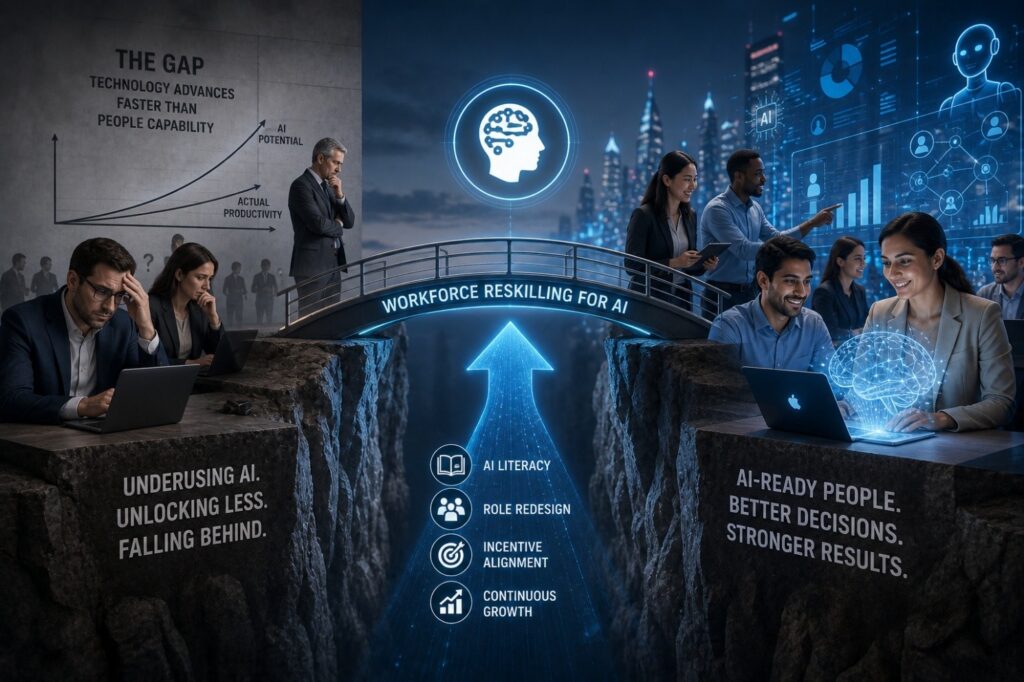
| The IT Trend Most Underestimated by Business Leaders in 2026: Workforce reskilling for AI. Most business leaders understand that AI will change their operations. Fewer have made meaningful progress on building the organisational capability to use AI well. The gap between the productivity available from AI tools and the productivity being captured is almost entirely a human capability gap, not a technology one. The organisations that close that gap fastest — through deliberate AI literacy programmes, role redesign, and incentive alignment — will be measurably more competitive by the end of 2026 than those that treat AI as a technology rollout rather than a culture change. |
Frequently Asked Questions — IT Trends 2026
What are the top IT trends for businesses in 2026?
The most significant IT trends for businesses in 2026 are: agentic AI (AI systems that take actions and execute workflows autonomously), cybersecurity consolidation and AI-assisted threat detection, intelligent automation that extends beyond simple rule-based processes, AI governance and EU AI Act compliance, workforce reskilling for AI capability, platform engineering and cloud-native development practices, quantum-safe cryptography planning, and sustainable IT measurement. These trends are interconnected — AI drives automation, governance, and workforce change simultaneously.
What is agentic AI and why does it matter for businesses?
Agentic AI refers to AI systems that can plan, decide, and take actions across multiple steps without requiring human approval at each stage. Unlike a chatbot that answers questions, an AI agent might pull data from a CRM, draft a response, send it, log the interaction, and update a record — all as a single automated workflow. For businesses, this changes the scope of what can be automated from simple, structured tasks to complex, multi-step processes that previously required human judgement. Organisations that map their highest-volume manual workflows and redesign them for AI agent execution will reduce operational costs and accelerate output significantly.
How should businesses prepare for the EU AI Act in 2026?
Businesses with operations or customers in EU markets should take three immediate steps: first, inventory every AI system in use and the decisions it influences; second, classify each system by the EU AI Act’s risk tiers — high-risk applications require documented human oversight, explainability, and audit trails; third, build governance infrastructure that demonstrates accountability, including decision logs, bias assessments, and human review checkpoints for high-risk AI decisions. Regulated industries (financial services, healthcare, HR technology) face the earliest and most stringent compliance deadlines.
What is quantum-safe cryptography and should businesses worry about it now?
Quantum-safe (or post-quantum) cryptography refers to encryption algorithms designed to resist attacks from quantum computers, which will eventually be powerful enough to break widely used current standards like RSA and ECC. NIST published the first set of quantum-resistant standards in 2024. Businesses should be concerned now — not because quantum computers can currently break encryption, but because migrating cryptographic infrastructure takes years, and ‘harvest now, decrypt later’ attacks are already collecting encrypted data to decrypt when quantum capability arrives. Organisations handling sensitive data with long confidentiality requirements should have migration planning underway in 2026.
What IT skills will businesses need most in 2026?
The most in-demand IT capabilities in 2026 span both technical and business-adjacent skills: AI engineering (building and deploying AI systems), AI operations (monitoring and governing AI in production), cybersecurity architecture (particularly for cloud and identity), platform engineering (internal developer tooling and infrastructure as product), data engineering and governance, and AI literacy at the business layer — the ability for non-technical staff to use AI tools effectively, validate outputs, and identify where automation adds value. The shortage is most acute in AI engineering and cybersecurity, where demand has significantly outpaced supply.
How is cybersecurity changing in 2026?
The dominant cybersecurity trend in 2026 is consolidation and AI-assisted detection. The previous decade of best-of-breed tool selection has left most organisations managing too many disconnected security products with too many integration gaps for modern threats to exploit. AI-assisted security operations — where a unified platform detects anomalies, correlates signals across endpoints, identity, and network, and recommends or initiates response actions automatically — is replacing the manual analysis that defined traditional SOC work. For businesses, this means prioritising vendor consolidation, investing in detection and response speed, and implementing Zero Trust architecture that assumes breach rather than defending a perimeter.
The IT Decisions That Matter Most in 2026
The most useful way to read this list of trends is not as a checklist of things to adopt, but as a map of the pressures your business technology environment is operating under. Agentic AI is compressing the time it takes to execute work. Cybersecurity threats are growing more sophisticated faster than defences are improving. Regulation is catching up with AI deployment. Workforces need to change how they work. The organisations responding to these pressures proactively are gaining ground on those that are not.
None of these trends requires adopting everything at once. The value comes from choosing the two or three that are most relevant to your specific business situation in 2026, making deliberate decisions about each of them, and building the organisational capability to execute. Technology strategy has always been less about knowing what exists and more about knowing what your organisation can actually absorb, deploy, and govern effectively.
That judgement — not the trend list — is what separates technology leaders from technology followers in 2026.
This article is for informational purposes only. Technology trends and regulatory requirements evolve rapidly. Always verify current capabilities, compliance obligations, and vendor information directly before making business or investment decisions.
Keywords: IT trends 2026 · top IT trends 2026 · business technology trends 2026 · agentic AI · cybersecurity 2026 · intelligent automation · EU AI Act compliance · quantum-safe cryptography · workforce reskilling AI · platform engineering · enterprise IT trends