What’s Actually Changing — and What It Means for Your Business
Updated 2026 | A Practical Guide for Technology Leaders, CTOs, and Cloud Practitioners
Written by cloud technology practitioners | For CIOs, CTOs, architects, and engineering leaders planning their 2026 cloud strategy
Cloud computing services for business stopped being a trend a decade ago. It became infrastructure. What happens in 2026 is not whether businesses move to the cloud — most already have — but how they use it more intelligently, more securely, and more efficiently as the underlying technology accelerates.

The trends worth paying attention to in 2026 are not the ones that cloud vendors are loudest about in their marketing. They are the ones that show up in where engineering teams are actually spending budget, what problems are causing the most friction, and which capabilities are moving from early adopter experiments to production workloads at scale.
The directional summary: 2026 is the year AI becomes inseparable from cloud infrastructure, edge computing crosses into mainstream production use, multi-cloud strategy matures from aspiration to architecture, and cloud cost and sustainability stop being afterthoughts. The businesses that navigate these shifts well will operate differently — and more competitively — than those that do not.
Here is a clear-eyed breakdown of the trends that will actually shape cloud computing this year — and what each one means in practice.
Cloud Computing Trends 2026 — Quick Reference
Here is an at-a-glance overview of the major trends, their likely impact, and what they mean in practice:
| Cloud Trend | Impact | What It Means in Practice |
| AI-native cloud infrastructure | High | GPU clusters, AI APIs, and model-serving pipelines built into the core of cloud platforms |
| Edge computing maturity | High | Processing moves closer to the data source — factories, vehicles, hospitals, retail floors |
| Multi-cloud by design | High | Deliberate workload distribution across AWS, Azure, GCP to avoid lock-in and optimise cost |
| Cloud security (Zero Trust) | High | Trust nothing by default; verify every request regardless of network origin or user identity |
| Sovereign and regional clouds | Medium | Government and regulated industries building cloud environments within specific national jurisdictions |
| Serverless and FinOps | Medium | Paying only for what you use; cloud cost optimisation becomes a dedicated engineering discipline |
| Green cloud and sustainability | Medium | Carbon-aware computing — running workloads during low-emission windows or in greener regions |
| Quantum cloud access | Emerging | Early quantum computing accessible via cloud APIs; still largely experimental but accelerating |
1. AI-Native Cloud Infrastructure
The most significant cloud shift in 2026 is not about storage, compute, or networking in the traditional sense. It is about the fact that every major cloud provider has restructured its infrastructure priorities around AI workloads — and this restructuring is filtering down to how every cloud customer designs, deploys, and operates their systems.
GPU and tensor processing clusters are no longer specialist hardware for AI research teams. They are general-purpose cloud resources that product engineers, data teams, and platform teams are all consuming. AWS Bedrock, Azure OpenAI Service, and Google Vertex AI have made foundation model access a standard cloud API — the same way S3 made object storage a utility in 2006.
The practical implication for businesses in 2026 is that AI inference is becoming a line item in cloud budgets for companies that never considered themselves AI companies. A customer support platform using a large language model for ticket classification, a logistics business using computer vision for package inspection, a financial services firm running fraud detection on streaming transaction data — all of these are now AI cloud workloads.
For cloud architects, this means designing for latency-sensitive inference pipelines, managing GPU resource contention, and making build-versus-buy decisions about model training and serving that did not exist as a mainstream consideration two years ago.
2. Edge Computing Crossing Into Mainstream Production
Edge computing has been ’emerging’ for long enough that the word has lost meaning. In 2026, it stops emerging and starts operating. The convergence of 5G infrastructure maturity, cheaper edge hardware, and the cost pressure of pushing all data to central cloud regions is driving genuine production deployment at scale.
The use cases that are crossing the threshold in 2026 are not the exotic ones. They are the operational ones: manufacturing quality control running on-premises because the latency of sending video frames to a cloud region for analysis is too high. Retail systems processing transaction and inventory data locally because internet connectivity is unreliable. Autonomous vehicle systems that cannot wait 100 milliseconds for a round trip to a data centre.
AWS Outposts, Azure Arc, and Google Distributed Cloud are all the same bet placed differently: that the future of cloud is a continuum from central region to edge node, not a binary choice. Cloudflare Workers and similar developer platforms are offering serverless compute distributed across hundreds of edge locations globally — and developer adoption is accelerating.
For businesses with physical operations, 2026 is the year to move from edge proof-of-concept to edge architecture. The question is no longer whether edge is viable — it is how to build operational discipline around infrastructure that lives on factory floors, store shelves, and moving vehicles rather than in controlled data centre environments.
3. Multi-Cloud Strategy Matures From Aspiration to Architecture
The promise of multi-cloud — use multiple providers to avoid lock-in, optimise cost, and pick best-of-breed services — has been genuinely difficult to deliver in practice. In 2026, the tooling has matured enough that deliberate multi-cloud architecture is becoming viable for organisations beyond the largest enterprises.
Kubernetes has been the most important enabler here. A containerised workload that runs on Amazon EKS will run on Azure AKS or Google GKE with manageable effort. The abstraction layer has become real enough to build strategy on, rather than just theory. Terraform, Pulumi, and similar infrastructure-as-code tools that abstract across provider APIs have removed a significant portion of the operational friction that made multi-cloud feel like more trouble than it was worth.
The honest version of multi-cloud in 2026 is not running identical workloads on three providers simultaneously as a resilience play. It is running the right workload on the right provider — AI model training on Google Cloud where GPU pricing and Vertex AI tooling is strongest, Microsoft 365 and Active Directory workloads anchored to Azure, high-volume object storage and Lambda functions on AWS — and having the architectural discipline to keep those choices from becoming spaghetti.
For technology leaders, the 2026 multi-cloud question is not ‘should we use multiple clouds’ but ‘how do we govern, observe, and cost-manage workloads across multiple clouds without creating a sprawl problem that costs more than the lock-in we were avoiding.’
4. Cloud Security — Zero Trust Becomes the Default Architecture
The perimeter-based security model — where everything inside the corporate network is trusted and everything outside is not — has been eroding for years. In 2026, it is effectively dead, and Zero Trust is not a forward-looking approach; it is the baseline expectation for any serious cloud security posture.
Zero Trust means every request — from a user, a service, an application, or an API — is authenticated, authorised, and audited regardless of where it originates. Being inside the VPN does not grant trust. Running on a corporate laptop does not grant trust. What grants access is continuous verification of identity, device health, and least-privilege entitlements.
The practical driver in 2026 is that supply chain attacks and identity-based intrusions have become more damaging and more frequent than traditional perimeter breaches. The 2024 and 2025 wave of cloud misconfigurations, stolen credentials, and third-party access abuse have made it commercially and reputationally untenable for organisations to defer Zero Trust implementation.
AWS IAM Identity Centre, Azure Entra ID, and Google BeyondCorp are the major platform implementations. But Zero Trust in 2026 is also about the discipline of applying it consistently — not just for human users but for service-to-service communication, API authentication, and the machine identities that often outnumber human ones in modern cloud architectures.
5. FinOps and Cloud Cost Discipline
Cloud cost has been a problem for years. In 2026, it is a strategic priority that has found its organisational form: FinOps, the practice of bringing financial accountability to cloud spending through the collaboration of engineering, finance, and business teams.
The scale of the problem is significant. Gartner and other analysts consistently find that organisations waste 30 to 35 percent of their cloud spend on unused resources, overprovisioned instances, forgotten development environments, and data transfer costs that were never modelled into architecture decisions.
What changes in 2026 is that FinOps stops being a reactive exercise — looking at bills after the fact and trying to understand the charges — and becomes a proactive engineering discipline. Cloud cost is embedded into architecture reviews, deployment pipelines that enforce tagging and budget guardrails, and engineering KPIs that include cost efficiency alongside performance and reliability.
Serverless and consumption-based pricing models are accelerating this shift. When you pay per invocation and per millisecond of execution, cost becomes directly legible from code. Teams that would never have thought about cloud economics in a provisioned-server model suddenly have strong incentive to write efficient, fast, stateless code — because the bill is the direct consequence of their engineering decisions.
6. Sustainable Cloud — Carbon-Aware Computing
Cloud providers have been making net-zero commitments for years. In 2026, the tooling to act on those commitments — and the regulatory pressure to report on them — moves from theoretical to practical for the businesses running workloads on those platforms.
Carbon-aware computing means scheduling flexible workloads to run when and where the electricity grid is cleanest. A batch processing job that needs to complete within a 24-hour window can be scheduled to run when the cloud region’s energy mix is predominantly renewable rather than at a fixed time that may coincide with peak fossil fuel demand. Google Cloud and Azure both have APIs and tooling that expose real-time carbon intensity data to enable this.
In 2026, the ESG reporting requirements expanding across the EU and increasingly in the US mean that technology leaders are being asked to quantify the carbon footprint of their cloud operations. The answer can no longer be ‘we rely on the provider’s sustainability commitments.’ It requires measurement, reporting, and increasingly, optimisation.
Where the Major Cloud Providers Stand in 2026
Not all cloud platforms are equal for all workloads. Here is how the major providers are positioned heading into 2026:
| Provider | 2026 Positioning |
| AWS | Broadest service catalogue; mature AI/ML tooling (Bedrock, SageMaker); strongest enterprise presence |
| Microsoft Azure | Deep Microsoft ecosystem integration; Copilot AI stack; strong for hybrid and government workloads |
| Google Cloud | Leading in data and analytics (BigQuery); Vertex AI; strong Kubernetes heritage; best for AI researchers |
| Oracle Cloud | Dominant in enterprise database migration; aggressive pricing for legacy Oracle workloads |
| Cloudflare / Edge | CDN-native developer cloud; global edge network; growing Workers platform for serverless at the edge |
The multi-cloud reality is that most large organisations use at least two of these providers in production, often for good reasons. The challenge in 2026 is not picking a winner — it is building the governance, tooling, and cost visibility to manage a multi-provider estate without losing control of either security or spending.
What This Actually Means for Your Cloud Strategy in 2026
Every trend listed here has a practical implication. Not all of them apply equally to every organisation — the right response depends on your current architecture, your industry, and where you are in your cloud maturity journey. But these are the decisions worth making deliberately rather than reactively:
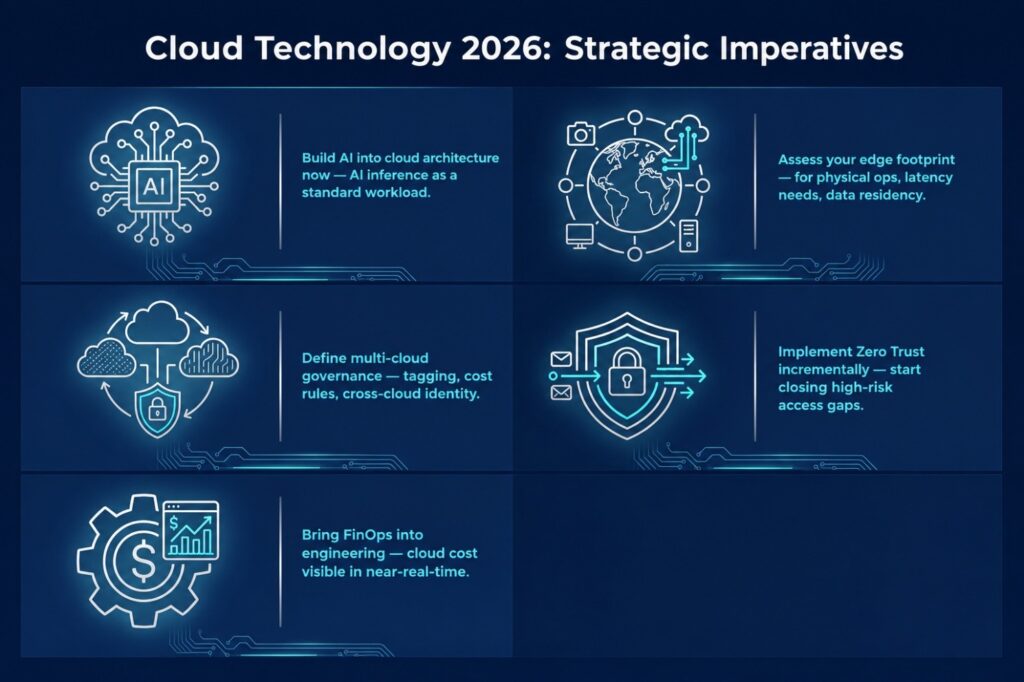
-> Build AI into your cloud architecture now, not later — AI inference will be a standard workload, not a specialist one. Designing your data pipelines, APIs, and observability stack to accommodate model-driven components is cheaper to do proactively.
-> Assess your edge footprint — if your business has physical operations, customer-facing systems with latency requirements, or data residency obligations, an edge computing assessment belongs in your 2026 technology roadmap.
-> Define your multi-cloud governance model before you need it — the time to establish tagging standards, cost allocation rules, and cross-cloud identity policies is before workloads are spread across providers, not after.
-> Implement Zero Trust incrementally but start now — Zero Trust is not a single project; it is an architectural direction. Pick the highest-risk identity and access gaps in your current cloud posture and close them systematically.
-> Bring FinOps into your engineering culture — cloud cost is an engineering problem, not a finance problem. If your engineers cannot see the cost consequence of their architecture decisions in near-real-time, you are flying blind on one of your largest operational expenses.
| The Cloud Trend Most Organisations Are Underinvesting In: Of all the trends in this guide, FinOps is the one where most organisations have the largest gap between awareness and action. Cloud cost optimisation typically delivers 20 to 35 percent in savings on existing spend — without reducing capability. For an organisation spending $500,000 per month on cloud, that is $100,000 to $175,000 per month recovered. The tooling exists. The practices are documented. The gap is almost always organisational: engineering teams are not incentivised to optimise cost, and finance teams cannot read the cloud bill. Closing that gap is the highest-ROI cloud initiative most organisations could take in 2026. |
Frequently Asked Questions — Cloud Computing Trends 2026
What are the biggest cloud computing trends in 2026?
The most significant cloud computing trends in 2026 are: AI-native infrastructure becoming standard across all major cloud platforms; edge computing crossing from pilot projects to production deployment at scale; multi-cloud architecture maturing from aspiration to operational reality; Zero Trust security replacing perimeter-based models as the baseline expectation; FinOps and cloud cost discipline becoming a core engineering competency; and carbon-aware computing emerging as a reporting and operational requirement. These trends are interconnected — AI workloads drive GPU cost challenges that FinOps must manage; edge computing creates new security perimeters that Zero Trust must address.
How will AI change cloud computing in 2026?
AI is restructuring cloud computing at the infrastructure level. GPU and tensor processing resources are becoming standard cloud infrastructure rather than specialist hardware. Foundation model access via API (AWS Bedrock, Azure OpenAI, Google Vertex AI) is making AI inference a utility — the same way compute and storage became utilities in earlier cloud generations. In 2026, organisations that never considered themselves AI companies will have AI inference costs in their cloud bills, AI-driven automation in their operations pipelines, and AI-generated outputs in their customer-facing products. The cloud architecture decisions that will matter most are how to design for AI workload latency, cost, and data governance.
What is the difference between multi-cloud and hybrid cloud?
Hybrid cloud refers to a combination of private infrastructure (on-premises data centres or private cloud) and public cloud services, connected and managed as a single environment. Multi-cloud refers to using multiple public cloud providers — typically a combination of AWS, Azure, and Google Cloud — for different workloads. An organisation can be both hybrid and multi-cloud simultaneously. In 2026, the more operationally relevant distinction is between multi-cloud done deliberately (with governance, cost visibility, and clear workload placement logic) and multi-cloud that happened organically (through departmental autonomy or acquisition) and is now a sprawl problem.
What is FinOps and why does it matter in 2026?
FinOps is the practice of bringing financial accountability to cloud spending through collaboration between engineering, finance, and business teams. It matters in 2026 because cloud costs have grown significantly for most organisations, and the traditional model of treating cloud as a utility bill managed by finance does not work — cloud costs are driven by engineering decisions that finance cannot interpret or control. FinOps creates shared visibility: engineers understand the cost consequence of their architecture choices; finance can forecast and budget cloud spend accurately; and business teams can make informed decisions about cost versus performance trade-offs.
Is edge computing replacing cloud computing in 2026?
No — edge computing is extending cloud computing, not replacing it. The relationship is complementary: edge nodes handle latency-sensitive processing close to the data source, while central cloud regions handle storage, long-running compute, analytics, and the authoritative control plane. In 2026, the most mature edge deployments are architected as extensions of a central cloud environment — using the same security policies, observability tools, and deployment pipelines, but with workloads distributed to where the data and latency requirements demand them.
What is Zero Trust and how does it apply to cloud security?
Zero Trust is a security model that assumes no user, device, or service should be trusted by default — regardless of whether they are inside or outside the corporate network. Every access request is authenticated, authorised based on least-privilege principles, and continuously monitored. In cloud environments, Zero Trust applies to human user access, application-to-application communication, API authentication, and the machine identities that cloud services use to communicate with each other. In 2026, Zero Trust is becoming the baseline expectation for enterprise cloud security rather than an advanced practice — driven by the frequency and severity of identity-based attacks and supply chain compromises.
The Cloud Strategy Decisions That Matter Most in 2026
The cloud services company in India is not slowing down, and the trends in this guide are not happening sequentially — they are happening simultaneously and they interact. AI workloads drive GPU cost challenges. Edge deployments create new security perimeters. Multi-cloud governance intersects with FinOps visibility. Zero Trust applies to human users and machine identities alike.
The organisations that navigate 2026 well are not necessarily the ones that adopt every trend on the list. They are the ones that understand which trends are most relevant to their specific situation, make deliberate architectural choices that position them to benefit, and build the organisational capabilities — governance, tooling, culture — to execute consistently rather than just strategically.
The cloud is not a destination. It is an operating environment that keeps changing. Staying current with how it is changing is part of the job of running technology in 2026.
This article is for informational purposes only. Technology trends evolve rapidly and specific capabilities, pricing, and availability of cloud services change frequently. Always verify current provider capabilities directly before making architectural or procurement decisions.
Keywords: cloud computing trends 2026 · top cloud trends 2026 · future of cloud computing · edge computing 2026 · AI cloud infrastructure · multi-cloud strategy · Zero Trust cloud security · FinOps · sovereign cloud · carbon-aware computing