
Your website is your most powerful sales tool — working around the clock, seven days a week. But what happens when it quietly starts working against you? In 2026, a slow, outdated, or poorly structured website doesn’t just look bad — it actively costs you customers, rankings, and revenue. Here are ten clear signals that a website redesign is no longer optional for your business.
In a dog-eat-dog world of professional services, where trust, credibility and first impressions directly affect a client’s decision to engage, your website is much more than a digital brochure. It’s your firm’s most visible asset, working 24/7 to build authority, communicate expertise and convert prospects into loyal customers. In 2026, when clients are doing more online due diligence than ever before, a website that looks dated, loads slowly or doesn’t inspire confidence can mean the difference between landing and losing a high-value engagement. Here are 10 signs that will make it obvious if your site is helping or hurting your practice.
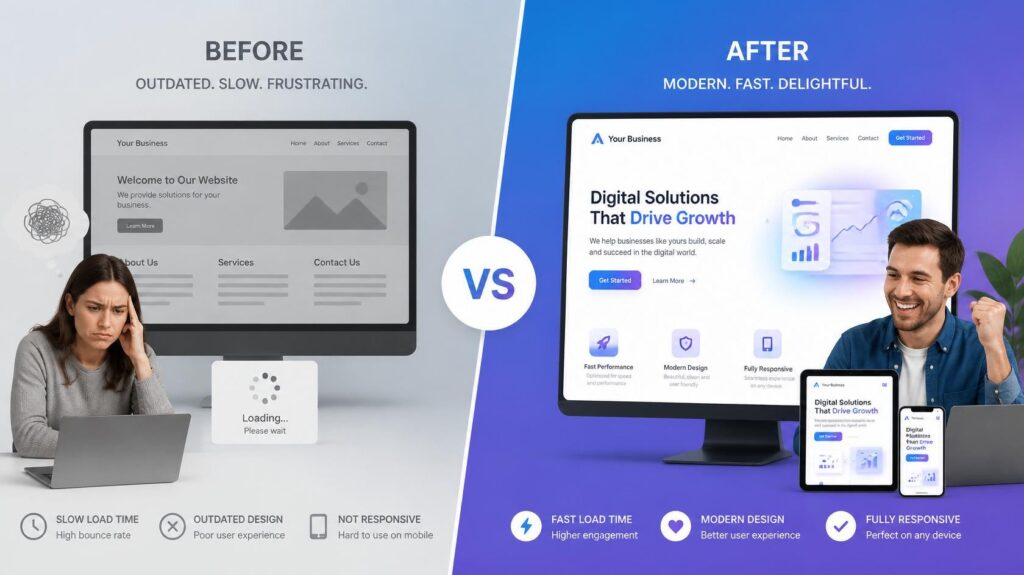
1.Your site loads in over 2.5 seconds.
Speed is no longer a nice-to-have, it is the biggest technical factor affecting both user experience and search visibility. Google’s Largest Contentful Paint (LCP) benchmark for 2026 is 2.5 seconds or less. And every second thereafter quietly eats your traffic.
💡 53% of mobile users will leave a page that takes longer than 3 seconds to load. Slow sites are not just annoying visitors. They are also penalised in Google Search rankings.
If your hosting is getting old, you’re filled with unused scripts in your theme, or your images aren’t compressed, these problems compound over time. A website development company allows you to start over from scratch on a clean, modern infrastructure.
2. Your bounce rate is increasing month over month
Bounce rate is one of the most subtle but clear warning signs in your analytics. If a visitor arrives on a page and immediately leaves without clicking anything, that tells you one thing: the page didn’t meet their expectation within the first few seconds.
They are caused by a poor visual hierarchy, confusing navigation, slow loading time, and an untrustworthy-looking design. If your GA4 data shows consistent month-on-month increases, don’t patch the symptoms, redesign the experience.
3. Mobile users are experiencing frustration
Worldwide, mobile devices make up roughly 64% of all web traffic in 2026. If your site forces visitors on smartphones to pinch, zoom, or scroll sideways to read your content, they’ll leave and visit a competitor who built with mobile in mind.
Industry research shows that 57% of internet users say they would not recommend a business with a poorly designed mobile site.
Google uses mobile-first indexing, meaning that it looks at your mobile experience first when it’s determining your search rankings. If your design looks good on a desktop, but breaks on a phone, it’s penalized twice: once by your visitors, and once by the algorithm.
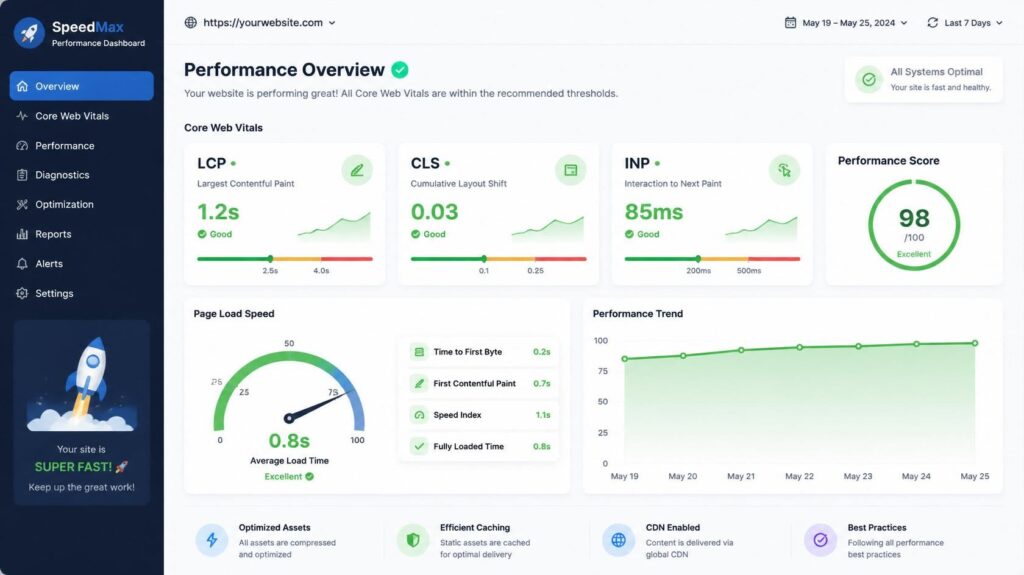
4. Your Core Web Vitals Are Not Good
Google’s Core Web Vitals, LCP (loading), INP (interactivity) and CLS (visual stability), are direct ranking factors. Google cares if your site has content that shifts around as it loads, buttons that take forever to respond, or images that push the page around.
Check out your site on Google PageSpeed Insights (pagespeed.web.dev) today. A failing score isn’t just a technical issue, it’s a revenue problem. Modern redesigns rebuild the technical foundation so Core Web Vitals are baked in, not bolted on.
5.Organic traffic has been dying silently
A consistent drop in organic search visits over several quarters is seldom coincidental. This usually means that either your content no longer matches search intent, or your technical structure has deteriorated, or your competitors have invested in better optimised sites.
💡 By 2026, the first position on Google receives up to 34% of all clicks, while the second page gets only 0.78%. A few spots down is not a minor setback, it’s a huge loss of potential customers.
A redesign, combined with a careful SEO migration strategy, can help recover lost ground and establish a stronger foundation for ranking in AI-powered search results and Google’s AI Overviews.
6. Leads and conversions are dead
If your traffic is steady but your enquiries, form submissions or sales aren’t growing with it that’s your conversion architecture. Visitors are coming, but something about the experience — unclear calls to action, confusing layout, poor trust signals — is stopping them from taking the next step.
Forrester research indicates that a seamless user experience can boost conversion rates by up to 400%. A redesign allows you to rebuild user journeys with a clear intent and reduce friction at every level of the funnel.
7. Your design is old fashioned compared to your competitors
A visitor forms an opinion of your website in just 0.05 seconds. If your site is still using 2019 or 2020 design patterns – heavy stock imagery, generic layouts, out-of-date typography – it tells prospects your business may be just as behind.
A dated design can be the reason someone clicks away to a competitor and never reads what you actually offer in industries where trust is everything. Visual credibility is a component of your brand promise.
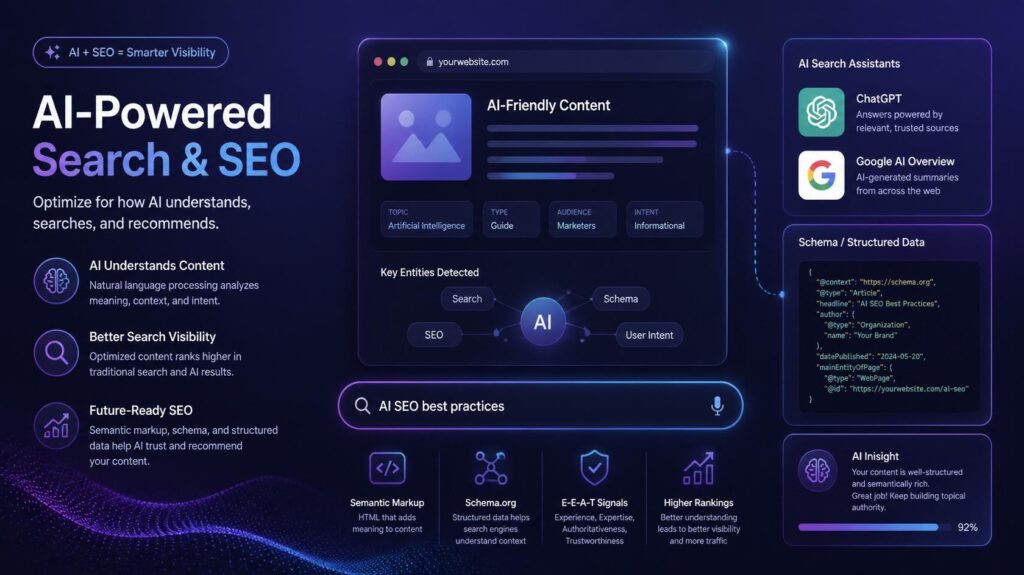
8. Your Site Is Invisible to AI Overviews and Answer Engines
In 2026, search has fundamentally changed. Google’s AI Overviews now reach more than 2 billion users per month, and platforms like ChatGPT and Perplexity are increasingly becoming the first place people go to discover businesses, compare services, and make decisions — often without ever clicking through to a website at all. If your site wasn’t built with this in mind, you’re not just losing ground in traditional search; you’re being bypassed entirely by the systems that now shape buying decisions at the very top of the funnel.
AI search traffic has grown by 527% year over year. These systems don’t favour the flashiest design — they favour content that is well structured, semantically organised, and built on a technically authoritative foundation. That means clean heading hierarchies, schema markup, concise and factually grounded content, and a site architecture that makes it easy for AI engines to understand what your business does and who it serves.
💡 A site designed for pre-2024 search behaviour is competing in 2026 with one hand tied behind its back.
9. Your website doesn’t show who your business is today
Businesses change. Services expand, teams multiply, positioning sharpens and brand recognition matures. But sites often become frozen at the point they were last built, sometimes years behind the business they are supposed to represent.
If your current site is not communicating your true value proposition, showing your real portfolio or speaking to the customers you are targeting today, it is creating a credibility gap between what you offer and what your visitors perceive. A redesign closes that hole.
10. Your CMS is hard to update, and your team shuns it.
A website that’s painful to maintain starts to get neglected. If your content team balks at updating pages because the CMS is confusing, if a simple edit needs a developer, or if adding new content breaks the layout — you have a structural problem that only a redesign can fix.
Visitors and search engines love fresh content, and regularly updated content is one of the strongest signals that your business is active and authoritative. A modern redesign on the right platform completely eliminates those barriers.
Frequently Asked Questions
How Often Should a Business Redesign Its Website in a Year?
Industry guidance has long been 2-3 years, but the rapid change in mobile standards, Core Web Vitals and AI-driven search has many experts in 2026 recommending you to review your site performance annually and do a complete redesign every 2 years if you are in a competitive space.
Will a redesign hurt my current SEO rankings?
It can, if you do it badly. A well-executed redesign with a solid SEO migration plan – URL mapping, 301 redirects and gradual post-launch monitoring – safeguards your current rankings and prepares you for improved performance in the future.
What’s the difference between a website refresh and a complete redesign?
A refresh changes visual elements such as colour schemes, fonts and imagery but keeps the underlying structure. A full redesign is a total rebuild of the information architecture, user journeys, technical foundation and content strategy. If you’re noticing four or more of the signs above, a complete redesign is usually the wiser investment.
How much does it cost to redesign a website in 2026?
Costs vary widely depending on scope, platform and agency/freelancer. A basic redesign for a small business or personal site typically sits at the lower end of the spectrum, while mid-size projects with custom features, integrations, or e-commerce functionality fall somewhere in the middle range. Enterprise-level redesigns involving complex systems, large team collaboration, and ongoing support tend to command the highest investment.
In an industry where reputation is everything, your website needs to reflect the excellence your firm delivers every day. If you’ve seen even a few of these warning signs, the cost of doing nothing more than a strategic redesign is far less than the cost of doing something. A modern, well-structured website development services in USA does not just look better. It builds credibility. It builds client trust. It drives qualified leads. It positions your firm as a leader in an increasingly competitive marketplace. Don’t let an outdated website be the weak link in your firm’s growth strategy — a well executed redesign is one of the most powerful business decisions you can make this year.
Bottom line: Most businesses don’t notice their website is failing until the impact shows up in a quarterly revenue report — and by then, the problem has usually existed for months. If you recognise three or more of the signs above, treat that as your data-backed signal to act. A well-executed redesign isn’t an expense — it’s one of the highest-ROI investments your business can make in 2026.
Quick audit resources:
• Google PageSpeed Insights: https://pagespeed.web.dev/
• Google Search Console: https://search.google.com/search-console
• Google Trends: https://trends.google.com/
© 2026 — SEO Blog | All rights reserved