
A Complete Guide for 2026
Think back to the last time something broke down at the worst possible time. A machine breaks down during the shift. Production stops. Engineers scramble. There are customers waiting. “Most people don’t realize how much familiar chaos is costing businesses. The frustrating part is that most of it could have been avoided.
And that’s exactly the problem that predictive maintenance with AI and IoT is solving today. Not by guesswork. Not on tight schedules. But with actual, live data from your own machines – analyzed by AI that learns what normal looks like and raises a hand the moment something starts going wrong.
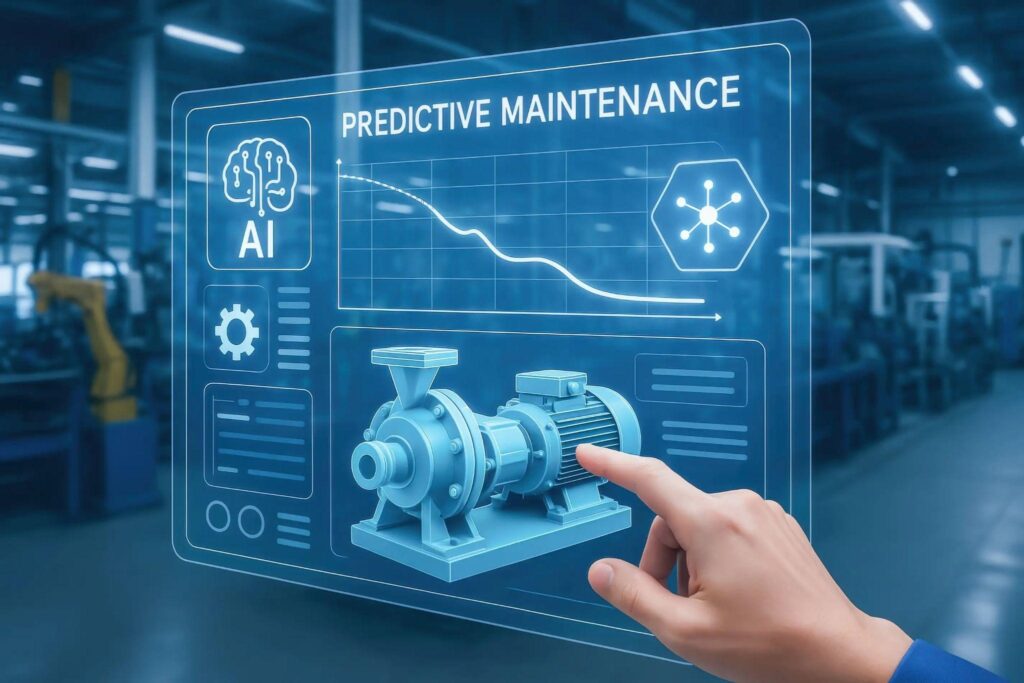
In 2026 this is no longer a cutting-edge experiment for global corporations. It’s a practical, approachable tool that companies of all sizes—from mid-size manufacturers to hospital facilities teams—are using to work smarter, spend less and avoid the surprises that hurt both operations and profits.
This guide walks you through what predictive maintenance actually is, how AI and IoT make it work, which industries are seeing the biggest gains, and how you can get started without needing a team of data scientists to do it.
What Is Predictive Maintenance — And Why Does It Beat the Old Way?
Most companies still manage their equipment one of two ways. Or they wait for something to break and then fix it – which is expensive, disruptive and sometimes dangerous. Or they have a maintenance calendar — servicing machines every thirty days regardless of need — which wastes time and money doing unnecessary work.
Predictive maintenance is a whole different ball game. It’s always watching your equipment, gathering data on how it’s really performing and using this information to tell you when something really needs attention – before it fails. The point isn’t to keep machines on a schedule. To keep them at the perfect moment.
That’s a simple way to think about it. An engine in a car that is about to fail does not just suddenly stop. In the days and weeks before it breaks , small things change . Oil pressure drops a little , temperature increases a little , there is a vibration you haven ‘t felt before . These are signals. Predictive maintenance uses IoT sensors and AI to process what those sensors find in your industrial equipment, twenty-four hours a day, listening for those signals.
How AI and IoT Actually Work Together in Predictive Maintenance
This is the part where most explanations get complicated. Let’s keep it simple.
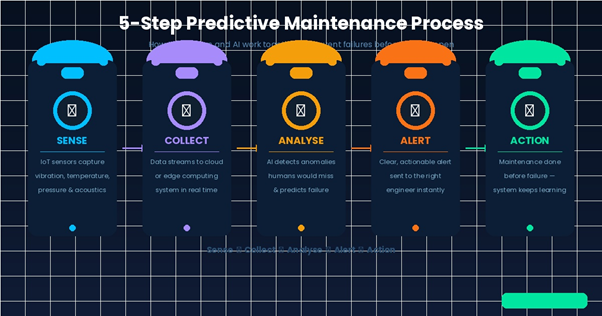
Step One — IoT Sensors Do the Watching
Small sensors are fitted to your machines. Depending on what you are monitoring, these measure things like vibration, temperature, pressure, sound, or energy usage. They do not need a person watching over them. They collect data continuously and send it on automatically.
Step Two — The Data Goes to a Useful Place
That sensor data stream is sent to a cloud platform or an edge computing system. Edge computing is gaining popularity in 2026 as it processes data at the source itself. This ensures faster decisions, lower costs, and no reliance on continuous internet connectivity. It is particularly useful in remote areas or places where immediate response is critical.
Step 3 — AI Finds What Humans Wouldn’t
That’s where the real smarts come in. A machine learning model is trained on the data of your equipment to understand what normal looks like. When the sensor readings start to drift from that baseline, even in ways too subtle for a human technician to notice, the AI flags it. It doesn’t just say something’s wrong. In more sophisticated systems it tells you what is wrong, what component is likely to fail and how long you have before it becomes a serious problem.
Step Four – Your Team Gets a Clear, Actionable Alert
The AI generated insight connects to your maintenance management system and sends a notification to the right person. Not a data wall, a clear alert. Machine 7, repair this bearing by Friday. That’s the kind of specific, timely information that turns data into action.
Step Five – The System Gets More and More Intelligent
Each time your team acts on an alert or even ignores one, the AI learns. The predictions get better over weeks and months. The system is more customized to your particular equipment, your environment, and your mode of operation.” It is not static. It grows as your business grows.
The Real-World Benefits That Are Driving Adoption in 2026
The numbers are only part of the picture. That’s what the move to predictive maintenance really means to the companies doing it:
Less surprises, More calm operations – The team can see the machine that’s going to fail before it fails and the whole operation just feels more in control. Less firefighting, less emergency call-outs, more confidence in everyday planning.
Lower Total Maintenance Spend – Stop paying for unnecessary maintenance, start paying for maintenance that actually prevents damage. The price difference is enormous, and it hits the pocketbook fast.
Machines That Last Longer – Catching small problems early prevents them from becoming big ones. Machinery that is always running in the safe zone just wears out more slowly. That prolongs the useful life of assets you have already spent money on.
Safer Working Conditions: Equipment that is about to break is equipment that can injure somebody. Predictive maintenance mitigates that risk by identifying deterioration before it becomes dangerous — a benefit that extends well beyond the balance sheet.
Better Use of Your Maintenance Team: Skilled technicians won’t waste time on routine check-ups that yield nothing but spend their time on the real issues that count. This is a better use of their expertise and a more satisfying way to do business.
Data You Can Use Every Alert. Every Pattern. Every Repair. Data That Leads To Smarter Decisions. Which machines are to be substituted? Whose parts are more durable? What are the operating conditions that give the maximum wear? Predictive maintenance transforms your equipment into a business intelligence asset.
Which industries are getting the most results right now?
Predictive maintenance with AI and IoT works wherever equipment reliability counts. The following are the fastest sectors of adoption in 2026:
Manufacturing: Industrial robots, production lines, conveyor systems and CNC machines are top targets. One unplanned stoppage on a high-output line can wipe out a day’s profit. Manufacturers represent the largest share of predictive maintenance adoption worldwide. [Text Wrapping Break]
Energy and Utilities: Turbines, generators and grid infrastructure are expensive, critical and often in difficult operating conditions. Utilities also use predictive maintenance to avoid failures that lead to widespread blackouts and expensive repairs.
Healthcare: No hospital can afford a broken MRI or ventilator. That’s exactly why healthcare is one of the fastest growing sectors for predictive maintenance — the stakes are so high, and the margin for error is so small.
Transportation and Logistics Airlines monitor engine health in real time. Railway operators are responsible for monitoring the state of track and rolling stock. Fleet managers check vehicle systems so cars don’t breakdown on the road. Predictive maintenance enables safe, timely movement of people and goods.
Oil, Gas and Mining: Remote, Dangerous and Costly to Access. In these environments, reactive maintenance is not only expensive, it can also be downright dangerous. IoT sensors enable teams to track critical equipment without sending engineers to sites unnecessarily.
[Text Wrapping Break]Aerospace and Defense: In aerospace and defense, where precision and reliability isn’t an option, predictive maintenance provides maintenance crews with the confidence of data, not just inspection schedules and hope.
How to Start with Predictive Maintenance Without Overwhelming Your Team
The primary barrier to the adoption of predictive maintenance is the misunderstanding that it necessitates a complete reorganization of the business. No it doesn’t. The most successful implementations start small and grow on purpose.
- Assess your highest risk assets – Don’t attempt to monitor everything at once. Select the two or three machines that would be most damaging if they go down. Begin there.
- Select the appropriate sensors for your machines – Rotating equipment vibration sensors Temperature sensors for motor and electrical systems. Hydraulic system pressure sensors. The type of sensor needs to correspond to the failure mode you want to catch.
- Link to a platform that works for your setup – Most businesses do well with cloud platforms. If you need real-time responses or have limited connectivity, edge computing is worth considering.
- Find a partner who knows your industry – AI models need data that is specific to your particular equipment to be trained. Working with a tech partner who understands your industry will get you to reliable predictions faster than if you do it yourself.
- Give it time to learn – The first few weeks are spent collecting data and calibrating. Don’t judge the system too soon. And in sixty to ninety days, you ought to start to see predictions that are really reflective of how your equipment is going to behave.
- Track your outcomes and develop the business case – Keep track of all failures averted. Avoided each repair. One hour of uptime every hour saved. That data will be there to help you easily justify expanding the program to more of your operation.
What Is Coming Next for Predictive Maintenance Technology?
The technology is already impressive. Here is where it is heading in the next few years:
• Edge AI is driving processing right out to sensors and gateways — which means real-time decisions that are not reliant on the cloud at all
• 5G networks are allowing for more sensors, more data, and new use cases in environments that legacy networks couldn’t support
• Digital twins — virtual replicas of physical machines — are enabling engineers to simulate thousands of failure scenarios before they happen in the real world
• Maintenance engineers without a data science background can now build and deploy their own predictive models using no-code AI platforms
• Acoustic monitoring – using sound patterns to detect faults – is growing fast as a complementary technique to vibration and temperature sensing
• Autonomous maintenance systems are starting to close the loop completely, not just alerting teams of problems but automatically scheduling the repair and ordering the parts
Ready to Stop Reacting and Start Predicting? | Your machines are already telling you what you need to know.
Talk to the team at Itensia about building a predictive maintenance solution that fits your business — not a generic template, but something built around your equipment and your goals.
Frequently Asked Questions
Q: What is the difference between predictive maintenance and preventive maintenance?
A: Preventive maintenance is a calendar-driven activity. You service equipment on a calendar basis, whether it’s needed or not. Predictive maintenance is all about real data, you maintain equipment when the numbers tell you something is really going wrong. This leads to fewer wasted service calls, less downtime from overlooked problems and more efficient use of your maintenance budget.
Q: Do I need a large team of data scientists to run predictive maintenance?
A: No longer. Many predictive maintenance platforms are built for maintenance engineers and operations managers, not data scientists, in 2026. No-code tools let your existing team set up monitoring, review alerts and action predictions without specialist technical knowledge. Where more sophisticated bespoke models are required it is usually more practical to partner with a technology partner such as Itensia, rather than build in-house.
Q: How quickly will I see a return on my investment?
A: Most businesses see measurable results within three to six months, especially in the form of reduced emergency repair costs and avoided downtime. As the AI model learns more about your particular equipment, the ROI tends to increase over time as predictions become more accurate. Starting with your highest risk, highest cost assets will get you the fastest visible return.
Q: What types of IoT sensors are most commonly used?
A: The most common used sensors are vibration, temperature, pressure and acoustic signal sensors. Vibration monitoring is the most commonly used technique and is very effective in detecting faults in rotating machinery like motors, pumps, compressors and fans. The best sensor for your situation depends on what sort of equipment you’re monitoring and what failure modes you care most about.
Q: Can predictive maintenance work in small and mid-sized businesses?
A: Yes – and it becomes more practical still. The cost of entry has been dramatically reduced by cloud based platforms, affordable IoT sensor hardware and no-code AI tools. You don’t have to oversee your entire operation at one time. For companies of any size it is a sensible and cost effective way to start with 2 or 3 critical machines and build from there.
Q: What is the role of edge computing in predictive maintenance?
A: Edge computing is when the data is processed at the machine or close to it, instead of sending all the data to a remote cloud server. This is critical when you need real time answers — for example in applications where a fault that takes minutes, not hours, to occur needs action immediately. It also cuts down on data transmission costs and enables predictive maintenance in remote or poorly connected locations.
Final Thoughts
All equipment will age. There will always be wear patterns and warning signs on machines. The difference between businesses that catch those signs early and those that don’t all comes down to one thing: are they listening?
AI and IoT enabled predictive maintenance gives you the ears to hear what your machinery is telling you — before it stops telling you. It’s not about replacing your maintenance team. It’s about giving them better information, better timing, better outcomes.”
If you’re thinking of taking that first step, Itensia works with companies just like yours at this exact stage – helping you understand where to start, what to look out for, and how to build a solution that scales with your business. Nothing more complex than that. No jargon. Just useful tech that does what it says on the tin.
Because the best maintenance is the kind that means your machines never let you down.
External References:
• MarketsandMarkets — Predictive Maintenance Market Report
• IoT Business News — Predictive Maintenance with IoT: From Sensors to Actionable Insights
• Fortune Business Insights — Predictive Maintenance Market Size 2034
• IBM Maximo — AI-Driven Asset Management
• McKinsey Digital — Industry 4.0 and Advanced Analytics
Focus Keyword: predictive maintenance AI IoT | SEO Keywords: predictive maintenance AI IoT | AI predictive maintenance 2026 | IoT predictive maintenance | machine learning predictive maintenance | industrial IoT predictive maintenance | edge computing predictive maintenance | predictive maintenance benefits | predictive maintenance manufacturing | IIoT predictive maintenance | digital twin predictive maintenance | AI powered asset management | Industry 4.0 maintenance | real-time equipment monitoring | predictive analytics maintenance | reduce equipment downtime AI | smart factory maintenance | condition-based monitoring IoT | predictive maintenance solutions | predictive maintenance guide
Backlinks & Resources:
• Itensia — AI & IoT Technology Solutions — https://itensia.com
• Itensia Services — https://itensia.com/services
• Itensia Blog — https://itensia.com/blog
• Contact Itensia — https://itensia.com/contact
• Itensia AI Consulting — https://itensia.com/ai-consulting
• IoT Solutions by Itensia — https://itensia.com/iot-solutions