
Building the Future of Urban Living
Picture this: You wake up and the traffic app has already rerouted your commute because the city detected an accident twenty minutes ago. Your electricity bill is lower because the neighbourhood reduced power usage during peak hours last night. The park near your home is cleaner because sensors told the city crew exactly which bins were full.
This is not a scene from a science fiction movie. This is what smart city technology looks like in action and it is already happening in cities around the world.
The way we build and manage cities is changing fast. Cities are becoming living, breathing, thinking systems that work for their residents every single day. In this blog, we break down exactly what makes a city smart, the technology behind it, and why this matters for all of us.
What Exactly Is Smart City Technology?
A smart city uses technology mainly data, sensors, the internet, and artificial intelligence to make urban life easier, safer, and more efficient. The goal is simple: make the city work better for the people living in it.
Smart cities use what is called the Internet of Things (IoT) a network of connected devices and sensors that collect and share data. Combined with AI and cloud computing, this data is turned into smart decisions that improve everyday city services.
The Key Technologies Behind Smart City Technology
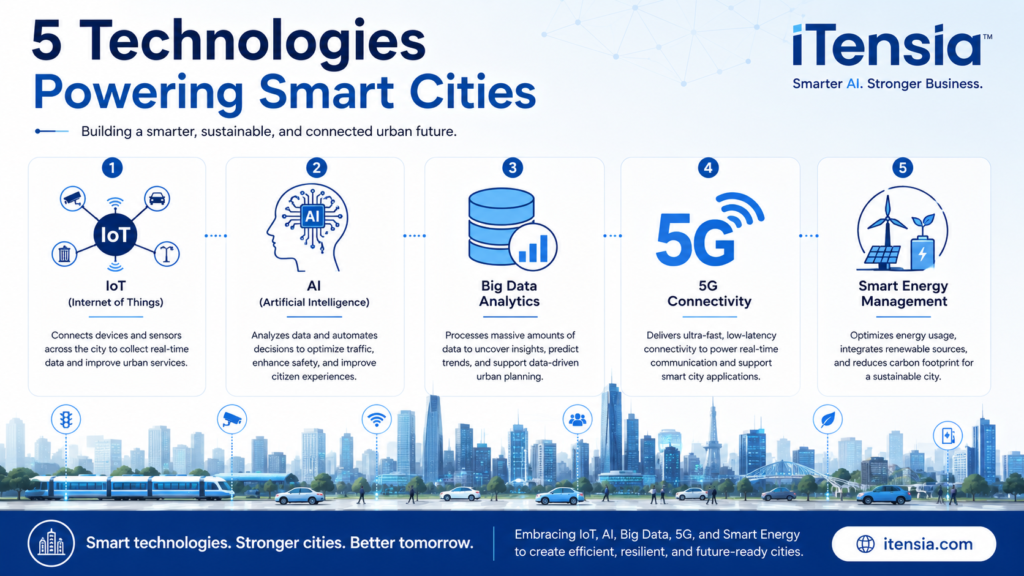
1. Internet of Things (IoT) The Nervous System
According to McKinsey, IoT sensor prices fell 40% between
2022 and 2025, making smart city technology more accessible
than ever.
IoT is the backbone of every smart city. Thousands of tiny sensors are placed across the city in roads, buildings, streetlights, water pipes, and rubbish bins. These sensors collect data around the clock. Real example: In Singapore, IoT sensors monitor air quality and crowd density in public spaces.
2. Artificial Intelligence The Brain Making Decisions
AI algorithms process massive amounts of data and help cities predict problems before they happen and allocate resources efficiently. This is the core of AI in urban planning. Real example: AI-powered systems in Barcelona predict where accidents are likely to occur, reducing response times significantly.
3. Big Data & Cloud Computing The Memory and the Muscle
Smart cities generate enormous amounts of data every second. Big data and cloud computing make it accessible to city departments instantly the foundation of data-driven urban development.
4. 5G Connectivity The Speed That Makes It All Work
For smart city systems to work in real time, they need ultra-fast internet. 5G allows millions of devices to communicate simultaneously making real-time city responses possible.
5. Renewable Energy & Smart Grids The Green Engine
Smart energy grids use real-time data to balance energy supply and demand, reduce waste, and integrate renewable sources like solar and wind efficiently.
10 Smart City Technology Trends Shaping Cities in 2026
Singapore: Often called the world’s smartest city, using an island-wide sensor network to manage traffic, energy, and public safety. Singapore consistently ranks as the world’s smartest city
according to the IMD Smart City Index.
Amsterdam: Invested heavily in smart energy grids and EV charging, making it one of Europe’s greenest cities.
Dubai: AI-powered police, blockchain-based government services, and self-driving taxis all part of their smart city initiative.
Pune, India: Smart surveillance, integrated command centres, and digital citizen services as part of India’s Smart Cities Mission.
How Smart City Technology Benefits Your Business
Smart cities create enormous opportunities for businesses of all sizes. As cities become more connected, businesses that adapt to and build on smart city infrastructure will gain a major competitive advantage.
- Access to city data for better market insights
- Faster logistics and delivery through smarter traffic systems
- Reduced energy costs through smart grid integration
- New market opportunities in IoT, AI, and smart infrastructure
- Better employee experience through improved urban mobility
If your business is looking to leverage technology, having the right tech partner makes all the difference. That is where Itensia comes in.
Want to Build Smarter? | The future of urban tech starts with the right partner.
Explore technology solutions for the future at itensia.com.
Final Thoughts
The cities of the future are not built on concrete and steel alone they are built on data, intelligence, and connection. Smart city technology is transforming the way we live, move, work, and breathe in urban spaces.
Whether you are a business owner or a curious resident, connect with Itensia and be part of building a better urban future.
The future is not something that happens to us. It is something we build together.
Frequently Asked Questions (FAQ)
Q1: What makes a city a ‘smart city’?
A: A smart city uses technology like IoT sensors, AI, and big data to make urban services like traffic, energy, and waste management more efficient, responsive, and citizen-friendly.
Q2: Are smart cities only for wealthy or large countries?
A: No. Many developing nations are actively building smart city infrastructure. India’s Smart Cities Mission, for example, is upgrading dozens of cities including Pune, Bhopal, and Surat with modern technology solutions.
Q3: How does a smart city benefit ordinary residents?
A: Residents enjoy shorter commutes, cleaner air and water, faster emergency response, better public transport, lower energy bills, and safer streets all thanks to the data-driven systems running behind the scenes.
Q4: Is privacy a concern in smart cities?
A: Yes, and it is an important one. Smart cities collect large amounts of data through sensors and cameras. Good city governance includes strict data privacy policies, transparent usage, and cybersecurity safeguards to protect residents.
Q5: How does 5G help smart cities?
A: 5G provides the ultra-fast, low-latency connectivity that allows millions of smart devices to communicate in real time. Without 5G, many smart city features like self-driving vehicles and instant emergency alerts simply would not work. Ericsson forecasts 5G will reach 3.5 billion subscriptions
and 60% global coverage by end of 2026.
Q6: How can my business get involved in smart city technology?
A: Businesses can participate by offering IoT services, data analytics, AI solutions, or infrastructure products. Partnering with technology experts like Itensia (itensia.com) can help you identify and enter the right opportunities.