WHY THIS MATTERS RIGHT NOW
Oracle ERP Is No Longer Just a System of Record — It Is a System of Action
For most of its history, an ERP system was essentially a very expensive database. You put data in, you pulled reports out, and most of the intelligence happened in the heads of the people sitting in front of it. That model worked — slowly, manually, and heavily dependent on skilled operators who knew how to ask the right questions at the right time.
In 2026, that model is obsolete for Oracle Fusion Cloud ERP users. Oracle has systematically embedded over 600 AI agents across its entire Fusion Cloud suite — ERP, EPM, SCM, HCM, and CX — at zero additional licensing cost. These are not chatbots bolted onto a legacy interface. They are purpose-built AI agents that sit inside financial workflows, payables processes, supply chains, and planning cycles, taking actions, detecting anomalies, and generating forecasts with minimal human intervention.
Organisations working with an experienced Oracle services partner like ITensia (itensia.com/solutions/oracle/) are already activating these capabilities and reporting seven-figure ROI in Year 1. The question for most enterprise leaders in 2026 is no longer whether to use AI in their Oracle ERP. It is why they have not started yet.
“Oracle reported FY2026 total revenue of a record $67.4 billion — up 17% — with cloud revenue surging 39% to $34 billion. The AI layer is not a feature anymore. It is the product.”
| 600+ AI agents shipped across Oracle Fusion Cloud suite in 2026 | $67.4B Oracle FY2026 total revenue — record high, up 17% YoY | 39% Oracle cloud revenue growth in FY2026 driven by AI adoption |
What This Guide Covers:
This article walks through every major way AI is transforming Oracle ERP in 2026 — from specific AI agents and agentic workflows to predictive planning, intelligent document processing, cloud security, and what your implementation team should be doing right now.
THE BIG SHIFT
From “AI Features” to “AI Agents” — What Oracle Has Actually Built
There is an important distinction that gets lost in most Oracle ERP AI coverage. Adding an AI feature means adding a smarter report or a better autocomplete. Deploying an AI agent means creating a system that can observe a situation, make a decision, and take action — on its own, inside your live business processes.
Oracle’s 26B release delivered a significant expansion of its agentic app portfolio. The ERP pillar alone now includes dedicated agents for the ledger, payables, expenses, and payments — each embedded directly inside the workflows where that work happens. Organisations that partner with certified Oracle ERP/SCM/HCM specialists such as ITensia (itensia.com/solutions/oracle/) are finding these agents can be configured and activated far faster than a traditional ERP feature rollout.
Oracle’s Six Most Impactful AI Agents in 2026
| AI Agent | What It Does in Practice |
| Ledger Agent | Monitors GL entries, flags anomalies, and surfaces reconciliation exceptions automatically during financial close. |
| Payables Agent | Handles invoice matching, three-way matching, and routing. Identifies duplicate invoices and policy violations in real time. |
| Expenses Agent | Automates the full expense lifecycle — submission, compliance checking, approval routing, and status updates via conversational interface. |
| Payment Agent | Optimises payment runs, detects fraud signals, and applies working capital rules intelligently across supplier payment schedules. |
| Security Command Centre | Analyses billions of telemetry signals, detects unusual access patterns, and flags insider threats using behaviour-based authentication. |
| SCM Agentic Apps | Ten new agentic apps in supply chain — Design-to-Source Workspace, Sourcing Command Centre, Cost Accounting Close Workspace, and more. |
Already a Fusion Cloud customer?
Most of these AI agents are included in your existing licence at zero additional cost. You do not need a new procurement — you need an activation plan. Working with a certified Oracle implementation partner like ITensia is the fastest way to map what is available and get features running in a sandbox environment within days rather than months. Visit itensia.com/solutions/oracle/ to schedule a free consultation.
FINANCE TRANSFORMATION
Predictive Planning and AI Financial Close — Where Oracle AI Is Saving Real Time
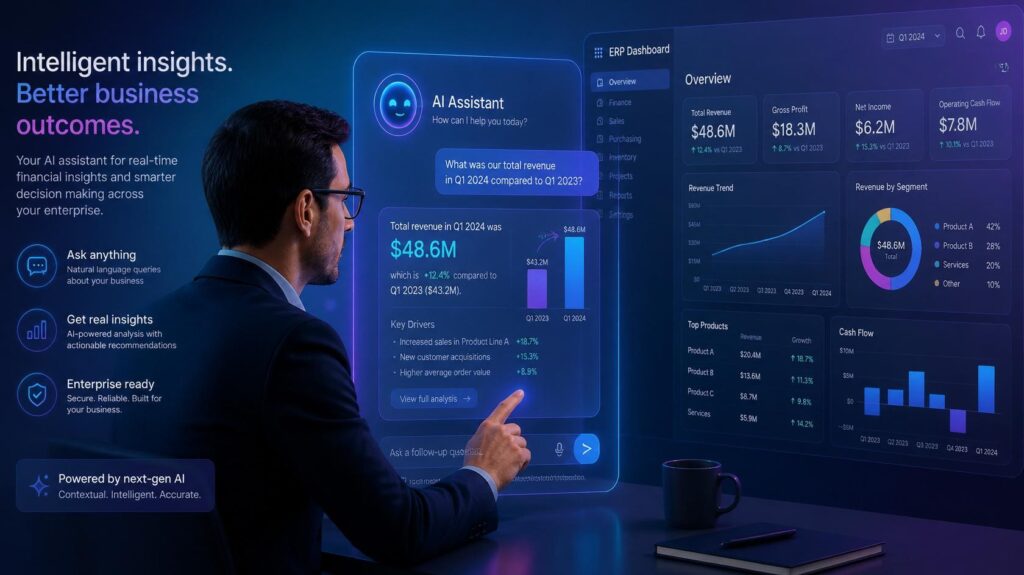
If you ask finance leaders in Oracle EPM Cloud environments which AI feature has delivered the most immediate, measurable value in 2026, the answer is almost always the same: Predictive Planning.
Here is what it does in practice. Instead of a finance team spending days building a forecast from scratch at the start of every planning cycle, Oracle’s AI generates a statistically grounded baseline automatically — using historical data, time-series analysis, and pattern recognition. The human team reviews, challenges, and refines that baseline, focusing energy on areas where judgment genuinely adds value rather than on mechanical data compilation.
IPM Insights — Anomaly Detection That Works Before Month-End
Alongside Predictive Planning, Oracle’s IPM Insights (Intelligent Performance Management) continuously analyses planning and consolidation data to detect anomalies, trends, and outliers. Instead of discovering that a cost centre is running 15% over budget at quarter-end, finance teams are alerted proactively — while there is still time to investigate and respond. This is particularly valuable during the time pressure of month-end close when the usual safeguards can slip.
Narrative Reporting With Generative AI
Oracle’s Narrative Reporting now includes AI-generated commentary — a feature that sounds minor until you have seen it in action. When building management reports or board packs, the system drafts narrative summaries of financial results based on the underlying data, highlighting key movements, variances, and trends in plain language. Finance professionals retain full editorial control, so the AI accelerates the process without removing human judgment from the result.
Real impact on planning cycles:
Organisations implementing Oracle Predictive Planning are reporting significant reductions in forecast preparation time across the board. Rather than building every month from scratch, analysts start from an AI-generated baseline and focus on refinement and strategic judgment. This is exactly the type of Oracle ERP optimisation that delivers measurable ROI within the first planning cycle after activation. ITensia helps enterprises activate these features as part of its full-lifecycle Oracle services — itensia.com/solutions/oracle/
USER EXPERIENCE SHIFT
Conversational ERP — Talking to Oracle Instead of Navigating It
One of the most significant shifts in Oracle ERP in 2026 is one that non-technical users will notice first: you can now interact with many ERP functions using plain language, the way you would ask a colleague a question.
Oracle’s Planning Agent, embedded within EPM Cloud, is a conversational AI assistant that can generate predictions, explain forecast variances in natural language, run root-cause analysis, and model what-if scenarios. Ask it ‘why did travel expenses increase in Q1?’ and it analyses the underlying data and provides a contextual, data-backed explanation — no report build required, no BI developer needed. For finance users who have spent years navigating complex ERP menu structures to get answers that should take thirty seconds, this is a genuinely significant quality-of-life change.
Oracle’s Planning Agent lets finance users ask questions in plain language and get contextual, data-backed answers — no report build, no BI developer, no waiting.
Oracle AI Agent Studio — Build Your Own AI Workflows
For organisations that need AI workflows beyond what Oracle ships out of the box, Oracle AI Agent Studio provides a low-code environment to build, configure, and deploy custom AI agents within Fusion Cloud. This is where having the right Oracle Cloud implementation partner makes a material difference — teams experienced in Oracle Fusion Middleware, Oracle Integration Cloud (OIC), and Oracle APEX development can configure bespoke agents that reflect your specific business rules, regional compliance requirements, and industry workflows far faster than an in-house team starting from scratch.
ITensia Oracle Services — A Trusted Oracle Implementation Partner
ITensia delivers full-lifecycle Oracle services for enterprises looking to harness AI in their ERP, EPM, SCM, and HCM environments. From Oracle Cloud migrations and AI agent configuration to Oracle Analytics Cloud deployment, ITensia Oracle-certified consultants help organisations activate intelligence already built into their existing Fusion Cloud licences.
| Oracle Service | What ITensia Delivers |
| Oracle Cloud Migrations (OCI) | Seamless lift-and-shift from on-premises to Oracle Cloud Infrastructure |
| Oracle ERP / SCM / HCM | Setup, configuration, and workflow automation for Oracle Fusion Cloud apps |
| Oracle Analytics Cloud (OAC) | Interactive dashboards and real-time reports for smarter business decisions |
| Oracle Integration Cloud (OIC) | API management and seamless connectivity with third-party systems |
| Oracle APEX Development | Customised enterprise applications using Oracle APEX, Java, and PL/SQL |
| Performance Tuning | Query tuning, indexing, and memory management for optimal ERP performance |
| Security, Compliance & Governance | Role-based access, encryption, auditing, and compliance framework setup |
| Oracle Database Management | Design, implementation, backup, tuning, and HA/DR strategy execution |
Schedule a free Oracle consultation: itensia.com/solutions/oracle/
A common implementation mistake to avoid:
Organisations that try to build custom AI agents before standardising their core ERP processes almost always struggle. AI agents depend on process consistency and clean data models. The most successful 2026 Oracle AI implementations started with a Fit to Standard approach — keeping customisation minimal — then layered in AI agents on a clean process foundation. A seasoned Oracle ERP implementation partner like ITensia will enforce this discipline from day one.
CLOUD FIRST
Oracle Cloud Migrations — The Prerequisite for Unlocking AI
Here is a reality check that does not appear in most Oracle AI coverage: if you are still running Oracle on-premises, none of the AI capabilities described in this article are available to you. Every AI agent, every Predictive Planning model, every conversational interface, and every anomaly detection feature sits inside Oracle Cloud Infrastructure. The migration from on-premises to Oracle Cloud ERP is not optional if AI transformation is the goal — it is the prerequisite.
The good news is that Oracle Cloud migrations have become significantly faster and less disruptive than they were even three years ago. Oracle’s own tooling has matured, partner methodologies have accumulated real-world patterns, and the Fit to Standard approach — where organisations adopt Oracle’s out-of-the-box cloud processes rather than replicating every on-premises customisation — has compressed migration timelines meaningfully. ITensia’s Oracle Cloud migration practice (itensia.com/solutions/oracle/) has delivered structured, low-risk migrations for enterprises across BFSI, Healthcare, Retail, and Manufacturing.
Oracle Cloud Infrastructure (OCI) is the foundation that makes every AI capability possible. On-premises Oracle systems cannot access AI agents, predictive analytics, or generative AI features.
OCI Architecture Skills Matter:
Not all Oracle implementation partners have genuine Oracle Cloud Infrastructure (OCI) architecture expertise. When evaluating partners for a cloud migration or AI activation project, ask specifically about their OCI certifications, experience with Oracle GoldenGate for data replication, and track record with Oracle Autonomous Database deployments. ITensia brings all of these capabilities through its enterprise Oracle Cloud practice at itensia.com/solutions/oracle/
SECURITY & COMPLIANCE
Is Your Oracle ERP Data Safe When AI Features Are Enabled?
This is the question every CTO and compliance team raises first when AI features are discussed for enterprise systems — and it is entirely the right question to ask.
Oracle’s approach is clear and architecturally sound. All AI processing for Oracle Fusion Cloud features runs on Oracle Cloud Infrastructure (OCI), entirely within Oracle’s own environment. Your business data is not shared with third-party AI providers — not OpenAI, not Google, not Anthropic. Oracle does not use customer data to train its AI models. Each tenant’s data remains isolated in OCI’s secure multi-tenant architecture.
For regulated industries — BFSI, Healthcare, and Retail in particular — Oracle has confirmed that its AI features comply with existing certifications: SOC 1, SOC 2 Type II, and ISO 27001. AI also actively strengthens the security layer itself, with the Security Command Centre analysing billions of telemetry signals, flagging unusual access patterns, and enforcing compliance monitoring for GDPR, CCPA, and HIPAA automatically. ITensia’s Oracle security, compliance, and data governance practice (itensia.com/solutions/oracle/) helps organisations configure role-based access, encryption, auditing, and compliance frameworks correctly from day one.
Zero Trust + AI in Oracle Cloud:
Oracle Cloud identity analytics now adds behaviour-based authentication and continuous verification, fully aligned with zero-trust principles. AI no longer just improves business workflows inside Oracle ERP — it is actively strengthening the security perimeter around the entire platform, making compliance easier to maintain as the system becomes more automated.
ACTION PLAN FOR 2026
What ERP Leaders Should Be Doing Right Now
The organisations winning with Oracle AI in 2026 are not the ones with the biggest IT budgets or the most advanced technical teams. They are the ones that started experimenting early — enabling features in sandbox, running small proof-of-concept workflows, and building organisational confidence before scaling. The right Oracle ERP services partner can compress that learning curve significantly, bringing real-world implementation patterns from across BFSI, Healthcare, Retail, Manufacturing, and other industries.
The organisations winning with Oracle AI in 2026 are not the ones with the biggest budgets — they are the ones that started activating features early, with the right Oracle partner.
Your Oracle AI ERP Implementation Checklist — 2026
- Audit which AI features you already have access to. Most Oracle Fusion Cloud customers can activate AI agents today without additional cost — start by mapping what is in your licence with help from an Oracle-certified consultant at ITensia (itensia.com/solutions/oracle/).
- Enable AI features in your sandbox environment first. Test Predictive Planning, IPM Insights, and conversational features in a non-production environment before rolling out to live finance teams.
- Standardise your processes before layering in AI. Clean data models and consistent process execution are the prerequisite for AI agents to work reliably. AI amplifies your process quality — good or bad.
- Identify two or three high-value use cases to start. For most organisations the highest immediate ROI comes from Predictive Planning, anomaly detection during close, and the Payables Agent for invoice automation.
- Train your finance users, not just your IT team. The most underestimated barrier to Oracle AI adoption is user confidence. Finance teams who understand what the AI is doing adopt it far faster.
- Leverage Oracle Integration Cloud (OIC) for connectivity. AI agents work best when Oracle ERP is connected to your broader technology ecosystem. Oracle Integration Cloud implementation ensures AI insights flow seamlessly between ERP, CRM, logistics, and analytics.
- Plan your Oracle Cloud migration if you are still on-premises. Every Oracle AI capability requires Oracle Cloud Infrastructure. Partner with ITensia (itensia.com/solutions/oracle/) to make the transition structured and low-risk.
- Review the Oracle 26B roadmap on Oracle Cloud Customer Connect. Fusion Apps roadmaps are published quarterly and show exactly what AI capabilities are coming in the next release cycle.
FURTHER READING
Authority Resources on Oracle AI and ERP
- ITensia Oracle Services — Full Lifecycle ERP Support — itensia.com/solutions/oracle/
- Oracle AI Apps for ERP — Oracle Official — oracle.com/erp/ai-financials/
- Oracle Fusion 26B Roadmap — Oracle Blog — blogs.oracle.com/fusioninsider/roadmaps
- AI in Oracle EPM and ERP — James & Monroe — jamesandmonroe.com/blog
- NetSuite AI in 2026 — The NetSuite Pro — thenetsuitepro.com
- IBM Oracle AI World Tour 2026 — ERP Today — erp.today
- Oracle 2026 Trends — CES Ltd — cesltd.com
- Schedule Oracle Consultation — ITensia — itensia.com/contact/
FREQUENTLY ASKED QUESTIONS
Oracle ERP AI — Questions People Are Actually Asking in 2026
Q How is AI being used in Oracle ERP in 2026?
Oracle has embedded over 600 AI agents across its Fusion Cloud suite — including Ledger, Payables, Expenses, and Payment agents in ERP, plus agentic apps across SCM, HCM, and CX. These agents automate transactions, detect anomalies, generate forecasts, and enable natural language interaction with ERP data, all at zero additional licensing cost for existing Fusion Cloud customers. Working with an Oracle services partner like ITensia (itensia.com/solutions/oracle/) is the fastest path from activation to measurable ROI.
Q What is Oracle AI Agent Studio and who is it for?
Oracle AI Agent Studio is a low-code environment embedded in Fusion Cloud that allows organisations and Oracle partners to build, configure, and deploy custom AI agents. It is particularly useful for enterprises needing AI automation beyond Oracle’s out-of-the-box agents — applying industry-specific rules to procure-to-pay, for example, or adding AI workflows for regional compliance requirements. ITensia’s Oracle APEX and Oracle Fusion Middleware expertise enables rapid custom agent development for BFSI, Healthcare, and Retail enterprises.
Q Does Oracle charge extra for AI features in Fusion Cloud ERP?
No. Oracle has embedded its AI agents and generative AI capabilities across the Fusion Cloud suite at zero additional licensing cost. Most customers already have access and simply have not enabled them. A conversation with an Oracle-certified consultant at ITensia (itensia.com/solutions/oracle/) can complete a licence audit in a single session.
Q What is agentic ERP and why does it matter?
Agentic ERP refers to AI agents that can autonomously initiate and complete multi-step business processes — not just answer questions, but take actions. Oracle’s agentic apps handle end-to-end workflows like procure-to-pay, financial close, and hiring with minimal human intervention. This is the shift from ERP as a system of record to ERP as a system of action, and it is the most significant architectural change in enterprise software in over a decade.
Q Is Oracle ERP data safe when AI features are turned on?
Yes. All AI processing runs within Oracle Cloud Infrastructure (OCI) and stays entirely within Oracle’s own environment. Your data is not shared with third-party AI providers and Oracle does not use customer data to train its models. For regulated industries, existing Oracle Cloud certifications — SOC 1, SOC 2 Type II, and ISO 27001 — extend to AI features. ITensia’s Oracle security, compliance, and governance practice (itensia.com/solutions/oracle/) helps configure these controls correctly from the start.
Q How can ITensia help with Oracle ERP AI implementation?
ITensia provides end-to-end Oracle services including Oracle Cloud migrations to OCI, Oracle ERP/SCM/HCM implementation and configuration, AI agent activation, Oracle AI Agent Studio customisation, Oracle Analytics Cloud (OAC) reporting, Oracle Integration Cloud (OIC) connectivity, performance tuning, and security and compliance governance. With Oracle-certified consultants and industry accelerators for BFSI, Healthcare, Retail, and Manufacturing, ITensia delivers Oracle AI transformation engagements across the USA, UK, UAE, India, and the Philippines. Visit itensia.com/solutions/oracle/ to get started.
SEO KEYWORD RESOURCE
Trending Oracle ERP AI Keywords — 2026
These are the highest-volume and fastest-growing search queries in the Oracle ERP and enterprise AI category. Use these to build your content strategy, internal linking, and paid search targeting. Search any keyword on trends.google.com for live search momentum data.
| Keyword | Search Intent / Notes | 2026 Volume |
| Oracle ERP AI 2026 | Primary buying intent — head term | Very High |
| Oracle Fusion Cloud AI | Product-specific — rising fast | Rising |
| Agentic ERP | Breakout concept — 2026 new | Breakout |
| Oracle AI Agents | Feature-specific — high intent | High |
| Oracle NetSuite AI | Product comparison — rising | Rising |
| Oracle AI Agent Studio | Developer / IT decision-maker | Emerging |
| Oracle Predictive Planning | Finance persona — high CTR | Rising |
| AI Financial Close Automation | Finance transformation keyword | Breakout |
| Oracle ERP Digital Transformation | Decision-maker head term | High |
| Oracle EPM Cloud AI | Finance planning persona | Rising |
| AI in ERP Systems 2026 | Informational — high volume | High |
| Oracle Intelligent Automation | Operational efficiency | Rising |
| Oracle Payables Automation | AP / finance persona | Rising |
| Oracle Cloud ERP vs SAP 2026 | Decision comparison — high CPC | High |
| Oracle ERP AI Implementation | Service intent — high conversion | Rising |
| Oracle Anomaly Detection ERP | Technical IT decision-maker | Emerging |
| Oracle NetSuite Next | Product launch — 2026 new | Breakout |
| Oracle IPM Insights | Feature-specific — rising | Rising |
| Oracle AI Supply Chain SCM | Operations persona | Rising |
| Oracle Autonomous Close | Finance transformation breakout | Breakout |
| Oracle ERP AI ROI | CFO / CTO decision intent | High |
| Oracle Fusion Generative AI | GenAI feature query | Rising |
| Oracle Cloud Infrastructure AI | OCI platform keyword | Rising |
| Oracle Analytics Cloud 2026 | BI & reporting persona | Rising |
| Oracle ERP BFSI Healthcare | Industry vertical — high value | High |
| Oracle Integration Cloud OIC | API & connectivity intent | Rising |
AI in Oracle ERP Is Not a 2027 Priority — It Is a 2026 Decision
The organisations building competitive advantage right now are activating Oracle AI features in their existing Fusion Cloud environments today. Your licence almost certainly already includes what you need. The right Oracle partner makes the difference between activation in weeks and waiting years.
Talk to ITensia Oracle Experts: itensia.com/solutions/oracle/
ERP Technology Editorial Team | July 2026 | itensia.com | All rights reserved